

#JUVEMILAN: TACTICAL ANALYSIS
Juventus 1-1 AC Milan
The story of Juventus and the start of their 2021/22 season has them going from bad to worse as they enter the relegation zone. Despite earning a draw against an in-form AC Milan team, Juventus still do not have any clear style of play, ideas in most phases of play, or a hint as to where it will come from. Disappointing is an understatement.
Milan fans and football fans as a whole should be happy with the way Milan have conducted themselves in the start of a new Serie A season. In stark contrast to last season, Milan are easily one of the most exciting teams to watch. Milan are beginning to look like a team that’s well coached. This tactical analysis will explain how Milan progressed the ball, how both teams structure their press, and why Juventus struggled to defend against Diaz, Leao, Hernández and Romagnoli.

MILAN’S LEFT SIDE ATTACKING PATTERNS
AC Milan frequently use the left side as a means of ball progression. Brahim Diaz and Theo Hernández have impressed so far this season for Milan, despite my critical evaluation of both of them in 2020/21. Diaz in particular has taken his role as Milan’s number ten in his stride. Diaz will often start in a central area like a traditional ten, then move into the left half-space or wide area. This movement, combined with width provided by Hernández and ball carrying from one of Milan’s capable ball-playing defenders, has led to one of many outlets for ball progression.
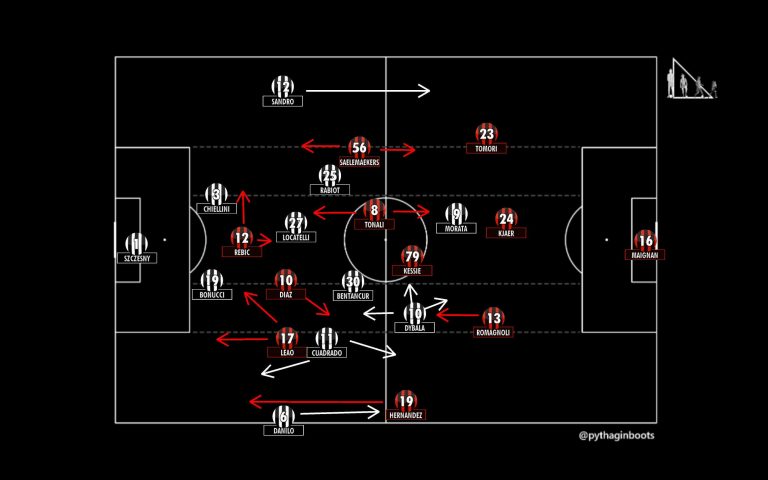
In their match against Juventus, Milan played to their strengths and continued down the left. Leao, who has also seen a streak of impressive performances, started on the left. As Milan kept possession, he could be seen playing as a forward partner to Rebic. When one of Milan’s defenders carried the ball forward, Leao would make angled runs that saw him move from the Juventus backline to their midfield line. This was done so that Bentancur would be overloaded as he was tasked with screening and marking Diaz.

Bentancur spent most of the game chasing shadows. His defensive responsibilities included pressing Romagnoli, screening or marking Diaz, while monitoring the runs from Leao who dropped into midfield. As the game went on, Cuadrado was tasked with chasing Hernández. This left space for Romagnoli to move into and more space for Bentancur to defend.

A change we’re seeing in Hernández’s game is his growing interest to play passes into the left half-space or central area of the pitch. In seasons past he would be keen to hug the touchline and cross from the byline. However, during this match, we can see the benefits of playing passes inside behind pressing players. Above we see Danilo pressing Hernández, while Cuadrado and Bentancur track back to handle the growing presence that is Leao. Diaz would move into the vacant space left by Cuadrado and Bentancur to receive short passes from Hernández. It’s a relatively simple idea; putting a player in space left by pressing players.
HOW JUVENTUS DEFENDED THE LEFT
To deal with Milan’s persistent use of the left hand side, Juventus used Cuadrado to mark Leao. This was most noticeable when Leao was against the Juventus backline as a second forward centrally, or when he moved in between the lines to the midfield line. This did not work well, but it was all that Juventus did. More often than not it led to Cuadrado being caught out of position. Danilo would press Hernández, leaving space for Leao to move into between the Juventus right fullback and right centre-back, dragging Cuadrado deeper into the final third, as seen below.

When Juventus kept a narrow low- to mid-block, Cuadrado was able to man-mark or screen Leao effectively. The left side passing play I praised earlier was simplified to just Hernández’s width. When Danilo remained narrow and gave Hernández space in the wide area, Leao could not move between Danilo and Bonucci anymore because there was no space to do so. This forced Leao to mostly operate in the left half-space, an area Diaz is most comfortable in.

The Achilles heel of Milan’s attacking ideas on the left is a narrow low-block. Without space to move into, Leao plays in a more central role. His best moments are when he’s out wide, one versus one. While a physical presence, he is not a long-term second forward. When you force Leao central, Milan’s play down the left slows to a crawl.
MILAN’S RIGHT SIDE ATTACKING PATTERNS
“If you can’t go to the left, go to the right” is a phrase that can be heard at most of the sessions I coach for my groups under twelve or thirteen. It’s nice to see that industry professionals are modeling their senior teams after my youth teams. More seriously, Milan uses a sequence of movements different from those used on the left, on the right. Diaz is seldom used on the right, the creative responsibility falls on Kessie.
Kessie will make a wide pass to his right fullback, in this game, Tomori. Once the pass is made, Kessie makes an angled run forward, dragging his marker Locatelli with him. Knowing that Locatelli will follow Kessie, Tonali and Rebic are invited to move into the space left vacant.

One of the benefits to movements like these is that they surprise the defending team. By the time Kessie has played the pass to Tomori and began his run, Tonali and Rebic are already moving to the space they expect to be left vacant by Kessie’s marker. The attacking team will always have a head start. Should Juventus become aware of this, they would have Locatelli forgo his man-marking so that they could defend the space that would otherwise be available.
The beauty of these movements is that if Juventus have Locatelli stop man-marking Kessie’s forward runs (which they did not), Milan will always have a back pass to a defender like Kjaer in the example below. If there is no forward, wide or central passing option, Milan can go backwards and restart their attack. Juventus will be punished against stronger teams for struggling to defend movements made off the ball.

PRESSING DURING THE BUILD UP
Juventus of old are not synonymous with aggressive pressing. Alas, a new stone has been turned and Juventus are changing. Knowing this, Milan welcomed a Juventus press by keeping the players used in the build up narrow and compact. This is done in an attempt to lure an even more aggressive press from Juventus.
By pressing so aggressively and so narrowly, this creates space behind the Juventus players vertically, as well as space on the opposite side of the build up. In the example below, the build up is taking place on the left, leaving the right vacant of any players, while also drawing five Juventus players into the Milan half, creating space behind them, straight ahead of Kjaer.

When Juventus sat deeper, their shape resembled a 4-4-2, with Cuadrado and Danilo being further away from their midfield and defensive lines as seen below. By taking up wider starting positions when defending from goal kicks or deeper build up plays, Cuadrado and Danilo give Milan a target to hit. During the build up, Hernández takes up a higher starting position, almost forcing one of Cuadrado or Danilo to mark him. The problems continued as Diaz would drop much deeper in the left half-space, drawing another marker, often Cuadrado.
Below we see how AC Milan may target the left side of the pitch by making a long pass, or by going short to Romagnoli and Diaz. Ultimately, the pressing structure that Juventus used did not favour the players in it, leading to a lopsided, disjointed shape that was easily exploited. Having said that, Milan struggled to capitalize on how poor Juventus press.

Juventus almost always use short goal kicks. If Juventus used long goal kicks, it’s often unclear what their target or plan is. Milan were able to press simply when Juventus went short. Milan presses in a 4-4-2, similar to Juventus, with the difference being Milan having players willing to do what is necessary.
If Juventus went to the left, like in the example below, Diaz would lead the press to the left. Diaz would press Bonucci while Leao closed down Danilo, and Rebic closed down Szczesny with Bentancur close by. Three Milan players can effectively press five Juventus players by pressing at an angle. For example, while Rebic is not directly marking Chiellini, Rebic is able to “defend” him by staying in front of him, making him an impossible passing option, all while being close enough to Szczesny and Bentancur to press when necessary.

THE PYTHAGORAS PERSPECTIVE
Last season, both Juventus and AC Milan could be best described as “directionless” when discussing their style of play. However, changes have been made to rectify that. Milan miss a presence like Giroud or Zlatan, yes, but the patterns and ideas are there, which could not be said of last season. There are options for Milan outside of relying on a strong forward and their ability to hold up the ball. I was critical of Milan last season, and rightly so. They were crowned “December Champions” and then massively fell off towards the end of the season stylistically, becoming a bore to watch. They’ve seemingly made a complete change in direction and are looking like one of the more exciting teams to watch in Serie A this season.
Juventus have had a slow start to the Serie A campaign. Despite sitting in the relegation zone, Juventus simply have too many quality players to be this poor for much longer. This was a sinking ship, it will take time to fix. If I was a Juventus fan I wouldn’t hold my breath however. Chances of top four look bleak not because of a slow start, but because of how exciting the competition looks compared to Juventus. Napoli, Inter, Milan and Roma are all far more entertaining to watch and are having immediate success with clear styles of play. Atalanta and Lazio also have a distinct way of playing, their exclusion from the current top four is through no real fault of their own either. Juventus will have a hill to climb and not one I expect to be conquered easily.
To access more tactical pieces follow us on Twitter @Pythaginboots


